mercredi 25 septembre 2013

Real Estate Websites in China


Real Estate Websites in China


The real estate market in China has become mature in a very short period of time. The internet has developed from very basic websites to sophisticated platforms in less than 10 years and the country might very well be ahead of other economies regarding that matter. 

There is still several categories of websites adversiting real estate in China. 


Chinese agencies websites


The first categories of websites where you can find real estate classifieds are the real estate websites of real estate agencies. These websites are definitely designed for Chinese customers and most of them do not even have english (or an other foreign language) versions. These are the oldest type of real estate websites in China and reflect the property portofolio of the companies, you can have a look on websites such as «  Wo Ai Wo Jia » or «  Century 21 China ». 


Real Estate classifieds on Expat websites


A disctinct category of websites that include real estate classifieds are the websites designed for foreigners such as the Beijinger, the Shanghaiist or City Week End
These websites are very specific and deal with classified aimed at foreigners. They are used by foreigners and are favoured by Chinese Real Estate agencies and landlords because of their preference for foreign tenants who have the reputation of behaving better with the apartments. Still, this is a marginal category.


Relocation Agencies Real Estate Websites.


For example, have a look on the Scout Real Estate Beijing website. These agencies have a niche market : the expatriates in Chinese large cities. Their websites are interesting to compare with Chinese websites because of their very different design, that looks clearer to westerners when Chinese websites have information scattered all over the screen. These sites are interesting as well because they select the most presigious compounds in China large cities, faithfully reflecting the market structure in China with a high grade real estate market limited to a few residences in prestigious city landmarks. With Chinese real estate market becoming more mature, this might evolve in the future but it is still a limited market.


Real Estate platforms, the Soufun success story

With Chinese real estate distribution network being more and more online, a new kind of website has emerged, the most inconic being Soufun. This is a very impressive platform with an open architecture, where agencies, landlords, developers and customers can register and interact, making it the most reliable source of real estate data in China. This is top notch website with a very modern interface, that proves how much the Chinese real estate websites have evolved in such a short period of time.


A new category : Chinese real estate websites for overseas properties

With Chinese real estate developemnt, Chinese investors want to diversify their portfolio or more simply set a foot outside China. This is a rising phenomenon illsutrated by the success of Juwai,  a website dedicated to properties overseas, with precise explanations about the areas where they are about to invest. This is a great success and responds to a clear need of Chinese customers.


lundi 2 septembre 2013

Break-even

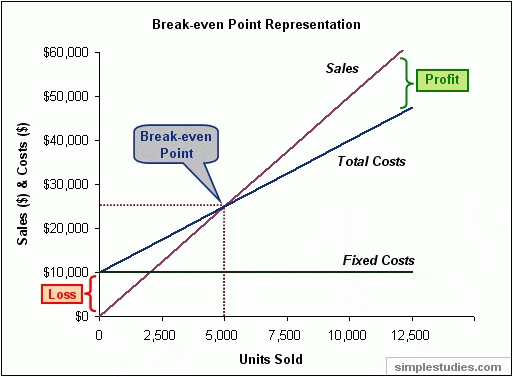
Break-even is the point where the profit and loss are exactly equal. This point reflects the moment when the investor can get returned after his investment. Break-even indicates also the point of balance between sales income and prime cost (use in distribution for example). At this point, theres’s neither profit nor loss, although opportunity costs have been paid. When a company fixes prices or decides its marginal profits, the break-even serves as a critical point of making profits. Therefore, it’s important to make use of the break-even point in management strategies. This point can be widely used in product marketing, investment or even a company’s entire business. In the option area , it is also helpful. For options, break-even indicates the exact market price that should be reached. Only at this price can buyers not be in a loss. Break-even analysis is a useful tool to study the relation among the fixed cost, changing cost and profits. The analysis shows in a visible and direct way when to get the costs returned with a chart or a formula. Through the analysis, we come to know, within a given price, what the size of production should be to cover the total costs. Similarly, we get to know, within a given quantity of production, what the price should be to cover the total coats.Usually, we use a chart as seen below to get the results. From the break-even point, we begin to make profits.


To make a more accurate analysis, we often use some formulas to work out the final results. It’s BEP = TFC/(SUP - VCUP). Here, BEP = Break-even Point, TFC = Total Fixed Costs, VCUP = Variable Costs per Unit of Production, SUP = Selling Price Per Unit of Production.

Nowadays, more and more companies apply the analysis for the sake of a better profit and favorable financing strategies. For the most of time, when one wants to open up a start-up, he should draw up a financial planning with which he can make a clear understanding of his further financial situation. This point allows him to make or modify others’ decisions. For example, if a company finds that his predefined investment can’t cover the total cost before arriving at break-even point, it may probably seek for other investors, cooperators or cut down its fixed cost(equipments, factories, administrative expenses, etc).

Though break-even is widely used in financial evaluation and profit-loss forecast, it has also some restrictions. Firstly, each analysis conforms only to a single product. Secondly, it’s difficult to classify the fixed cost and the changing cost. Sometimes, the functional relation between the prime cost and income has changed, but the operator doesn’t recognized it. So with the previous analysis, he or she may get wrong results, which could lead to a loss.

mercredi 14 août 2013

Store-check

Store-check is a tool widely used in marketing research as to review the merchandises in a retail store by non-sales researchers whose responsibilities are to perform such field examinations. Store, in marketing research, means to put one’s products into others’ distribution canals in China. It’s a method often applied to launch new products or to explore new markets. Store-check, together with retail studying, aims to know the final markets through market share and the competition on the shelves. Store-checks are done from a micro angle to see how the products are displayed and how they are sold.


In a store-check, we can get much information as below.

l  Brand visibility. It means how often we can see a band on the basis of the sample. For example, if 100 out of the sample size 200 can be seen, the brand visibility is 50%(100/200).
l  Product visibility. Taking the sample size as the base, we come to know how many of them have presented the products. For instance, if 50 out of the sample size 200 can be seen, the product visibility is 25%(50/200).
l  Category visibility. Taking the sample size as the base, we come to know how many categories can be seen in a retail store. Attention, here, brand is not taken into account. For example, if 120 out of  the sample size 200 can be seen, the category visibility is 60%(120/200).
l  Relative visibility. It means what the product visibility is within the category visibility. For instance, if the sample size is 200, the category visibility is 60%, the product visibility is 50%, then the relative visibility is 83.3% (50%/60%).
l  Weighting visibility. The product visibility is based on the weighting allowance made by the company itself. For instance, the visibility of product X of Brand P near schools is 50%(0.2 weighting allowance), the visibility in restaurants is 60% (0.3 weighting allowance), the visibility in supermarkets is 90%(0.4 weighting allowance).So , the weighting visibility is 50%×0.2+ 60%×0.3+90%×0.4=64%
l  Compared with store rate, the visibility considers the products that are displayed on the shelves.

For the most of time, a company which performs such a studying attempts to compare its products with those of the competitors, as the following charts shows. 


When we set about to a store-check, we should pay attention to :

l  We should select the targeted stores in different regions of a city so that the results will be representative.
l  We should ensure that the researcher’ role is not recognised by the sellers so that the results will be authentic.
l  We can reexamine the check with a few samples to make sure of the check’s credibility.
l  The researching statistics should be logged accurately as soon as possible.

Before we start our operation, we should be clear about the objective, define the researching contents and draw up an outline. Then we should be care of the date , regions and the sample size. At last, it comes to write the report after the research is over.

jeudi 1 août 2013

Distribution of wine in China

China’s wines history start of Envoy Zhang Qian in the Han Dynasty.Zhang brought back the grapes and wine brewing process.From thisChinese people grasp the wine brewing process.In 1915,China’s wine appears in the 1915 Panama Pacific International Exposition.And it won the gold medal.Chinese wine was commended in the world wide.

In the past few years, China, the world's second largest economy, has risen to become one of the world's most important wine markets, offering both high growth potential and generous profit margins. By volume, the country is currently the seventh-largest consumer of wine, with expected sales of 1.6 billion bottles in 2011. In contrast, the U.S. and France, the first and second largest consumers of wine, are expected to consume 4.0 billion and 3.9 billion bottles, respectively. Since 2006, the Chinese market has experienced more than 20% annualized growth, and experts predict it will further double by 2014 to become the world's sixth largest.


Collectively, three major domestic producers account for nearly half the total wine sales in China. The largest brand, Changyu Pioneer Wine, is a unit of the major state-owned conglomerate China National Cereals, Oils, and Foodstuffs Corporation (COFCO). Changyu and the other two primary producers, Great Wall Wine and Dynasty Wine, focus on domestic consumption, with 98% of their production remaining in China.
Foreign wine imports are also growing rapidly. In 2010, imports grew to more than 20% of total wine consumption, a four-fold increase since 2005. Reductions in tariffs following China's accession to the WTO have been one factor in this growth. Currently, an estimated 20 million adults drink imported wines on at least an occasional basis. Given that this figure is a fraction of the overall estimated 200 million plus people who have the purchasing power to buy imported wine, the future for foreign wine appears bright.

Chinese wine market survey

Based on the Baidu index,currently,wine in the degree of concern of Chinese cities,Beijing, Shanghai, Guangzhou which three China's most economically developed cities are the top three.We found Zhengzhou, Chengdu, Xian, Wuhan which four Chinese inland cities in the top ten .Chinese wine market is developing. This shows , in china’s inland cities , more and more people focus on wine.According to information related to wine search. How to homemade wine? This is the top question.More and more people understand the knowledge of wine and willing to try drinking wine.China has a huge wine market .It is rising phase.

China’s wine market :Domestic wine vs Imported wine

We compared the wine, imported wine, domestic wine these three keyword search data. The data of Concerns imported wines shows ,Beijing, Shanghai and Guangzhou are still among the top three.And Zhengzhou, Xiamen which Chinese second-tier cities have high concern.The data of domestic imported wines has some changes.Zhengzhou, Taiyuan, Xian and other second-tier cities in China are the top 10.Compare the imported wine and domestic wine .These second-tier cities is also Concerns imported wines.And these cities, concern for imported wines is also an increasing trend.


lundi 1 juillet 2013

A NEW STAGE OF THE CHINA MASS DISTRIBUTION

« The large distribution in China entered a new stage of development » assures Guo Geping, the president of the association of chains and franchising of China, in the columns of Caixin Century. « Rules, structure and environment of the market must be reconsidered. "

The actors of the sector have to adapt themselves to a new situation, where the competition is aggravated and the increasing operating costs rapids, adds Guo Geping. The big foreign groups have other solution no than to adjust their strategy. Li Ling, a public relations manager of Wal-Mart so explains to the weekly on which the company decided to concentrate on the improvement of the quality in its stores ready more than on the opening of new points of sale. The group also plans to dash into the e-commerce, rapidly expanding in China.


For example, Wal-Mart plans the opportunity to acquire 51 % of the e-supermarket The Store and that its platform of on-line sale would be taken for a trial period at present. The Chinese distributors already ready quarrel ardently the market with cost of price war and easy terms. « We do not know to what extent the foreign companies will be capable of competing. », concludes Caixin Century with a note of pessimism.